

Most people moving to Florida sort the car out last. The house closes, the movers get booked, the flights go on the calendar, and somewhere in the final week somebody remembers there is a vehicle sitting in the driveway that also has to get there. It feels like the easy part. It is the least flexible part of the entire move, and treating it as an afterthought is what turns a straightforward relocation into three weeks of borrowing rides.
The reason has nothing to do with the shipping company you pick. It has to do with how car transport is scheduled, and with a thirty day clock that starts running the moment you arrive, whether or not your car has.
The Moving Truck Bends. The Car Does Not.
A household moving company sells you a delivery window. Four days, sometimes a week or more on a long haul. They can flex because they are carrying your boxes alongside two or three other households and they can shuffle the order.
Car transport does not work that way. Your vehicle is one of nine or ten slots on a specific trailer, driven by a specific person who has already built a route that touches five states in a particular order. He is not going to reverse his sequence for one car. So the pickup date you are offered is not a promise from a company. It is an estimate of when a driver heading that direction will have a slot free at your end of the route.
That is the whole game. When a broker quotes you a price, they are posting your car to a national load board where independent carriers look at available freight and decide what is worth driving. If the number works for a driver running your lane that week, it moves quickly. If it does not, the car sits on the board while trucks fill up with better paying loads around it. Nobody is ignoring you. The load simply is not competitive yet.
Which means the single biggest thing you control is not the price. It is how much lead time you give the system to find you a truck.
Thirty Days Starts With You, Not With the Car
Here is the part that catches people, and it is the reason the delivery date matters more than most first time shippers realize.
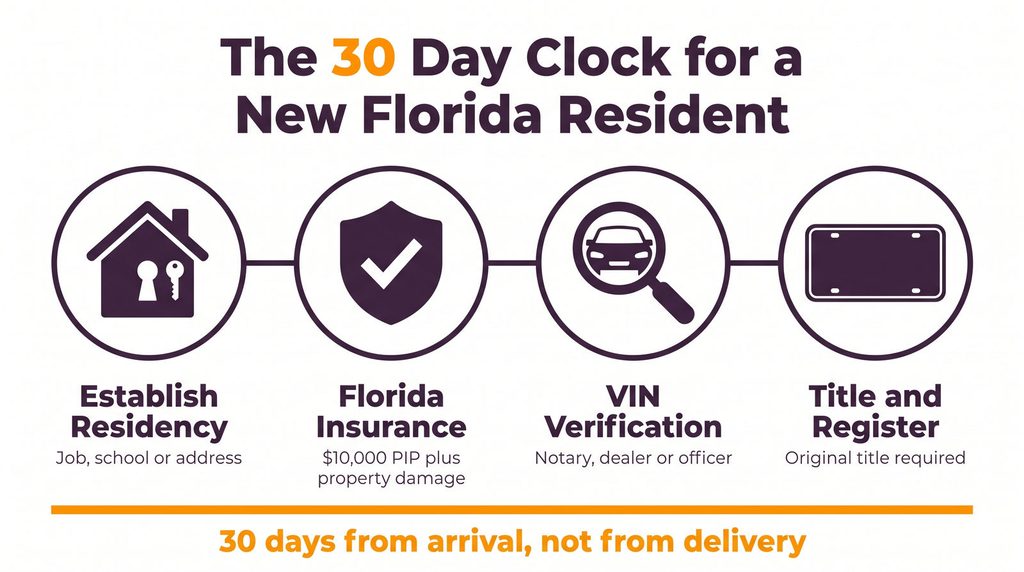
Florida gives a new resident thirty days to title and register an out of state vehicle, and that window opens when you establish residency, start a job, or enroll a child in school. It does not wait for your car to show up. If you fly down on the first of the month and your vehicle arrives on the twenty sixth, you have four days left to finish a process that has several moving parts.
Those parts are worth knowing before you book anything. You need Florida insurance in place first, and Florida requires a minimum of ten thousand dollars in personal injury protection plus property damage liability. Your out of state policy does not carry over for this. You also need a VIN verification, which is a physical check of the number on the car against the number on your paperwork. You can do that at a tax collector service center, or have the form completed by a Florida notary, a dealer, or a law enforcement officer. And you need the original title, which is a problem if your lender is holding it, because requesting it from them takes its own couple of weeks.
None of that is difficult. All of it takes time you may not have if the car lands late. The practical move is to work backwards: pick the date you want the car in your hands, subtract a week of buffer, and book from there rather than from the day you happen to remember.
Read: How to Prepare Your Vehicle for a Safe Long-Distance Road Trip
The Florida Lane Runs on a Calendar
Florida is not an ordinary destination. It has a season, and the season shows up in the price.
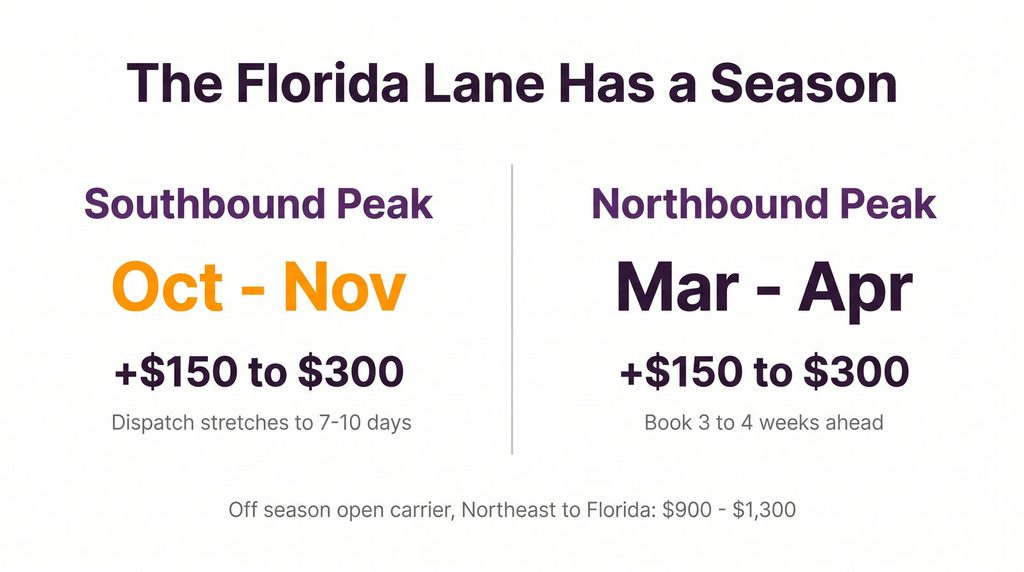
Southbound demand peaks in October and November as people head down for the winter. Northbound peaks in March and April as the same vehicles go home. In those windows, expect roughly a hundred and fifty to three hundred dollars above the off season rate on the same route, and if you book late inside a peak window, two hundred to four hundred above a normal quote is common. A car that dispatches in two or three days in July can take seven to ten days in November, simply because every truck heading south is already full.
For a rough baseline outside those peaks, an open carrier from the Northeast down runs somewhere around nine hundred to thirteen hundred dollars, and from the Midwest closer to eight hundred to twelve hundred. Enclosed transport sits meaningfully higher, usually in the twelve hundred to eighteen hundred range from the Northeast. Anyone planning to ship a car to Florida during the fall rush should be booking three to four weeks out, not three to four days.
The imbalance is worth understanding too. When thousands of cars move in one direction at once, trucks returning the other way run with empty slots, and carriers price accordingly. That is why the same route can cost noticeably different amounts depending on which way you are pointed and what month it is.
Hurricane Season Changes Routes, Not Plans
Hurricane season runs from June through November, and it affects car transport far less dramatically than people expect, but in a way that is easy to misread.
Carriers do not drive into a storm. What happens instead is rerouting and waiting. A driver who would normally run I-95 straight down the east coast may swing inland, add a day, and come in from the other side. Deliveries in an evacuation zone get held until the roads reopen and fuel is available again. The car is fine. The schedule is not.
The mistake is assuming this is rare enough to plan around. In practice, a late summer or fall delivery into Florida should simply carry two or three extra days of slack in your own planning. Not because anything is likely to go wrong, but because a two day delay only becomes a crisis if you built a schedule with no room in it.
What Actually Sets Your Pickup Date
When you call for a quote, the thing that determines how quickly your car moves is rarely the company on the invoice. It is the combination of your route, your flexibility, and whether your number is competitive on the board that week.
Popular lanes into Florida from the Northeast and Midwest move fast because trucks run them constantly. A pickup in a rural area two hours off the interstate takes longer, because a driver has to justify the detour against the miles. Being able to say that any day in a three day window works, rather than insisting on a Tuesday, is often worth more than negotiating fifty dollars off the rate. Operators such as Rivalane Auto Transport will tell you the same thing, because dispatchers see it every day: flexible loads get covered first.
The other thing worth doing is emptying the car. Personal belongings are not covered under a carrier’s cargo insurance, and a trunk packed with boxes adds weight the driver has to account for at the scale house. Leave about a quarter tank of fuel, hand over one key, and photograph the vehicle from all four corners in daylight before it goes on the truck.
Book the car before you book the movers. It is the only piece of the move that cannot be rescheduled by a phone call.